12V power
Dual battery systems for vans and utes: what you need, and why
A second battery runs the fridge and lights without flattening the one that starts the engine. The parts are simple; getting them matched to your vehicle's alternator is the whole job.
Hitch & HighwayChecked 3 October 202610 min read
Quick answer
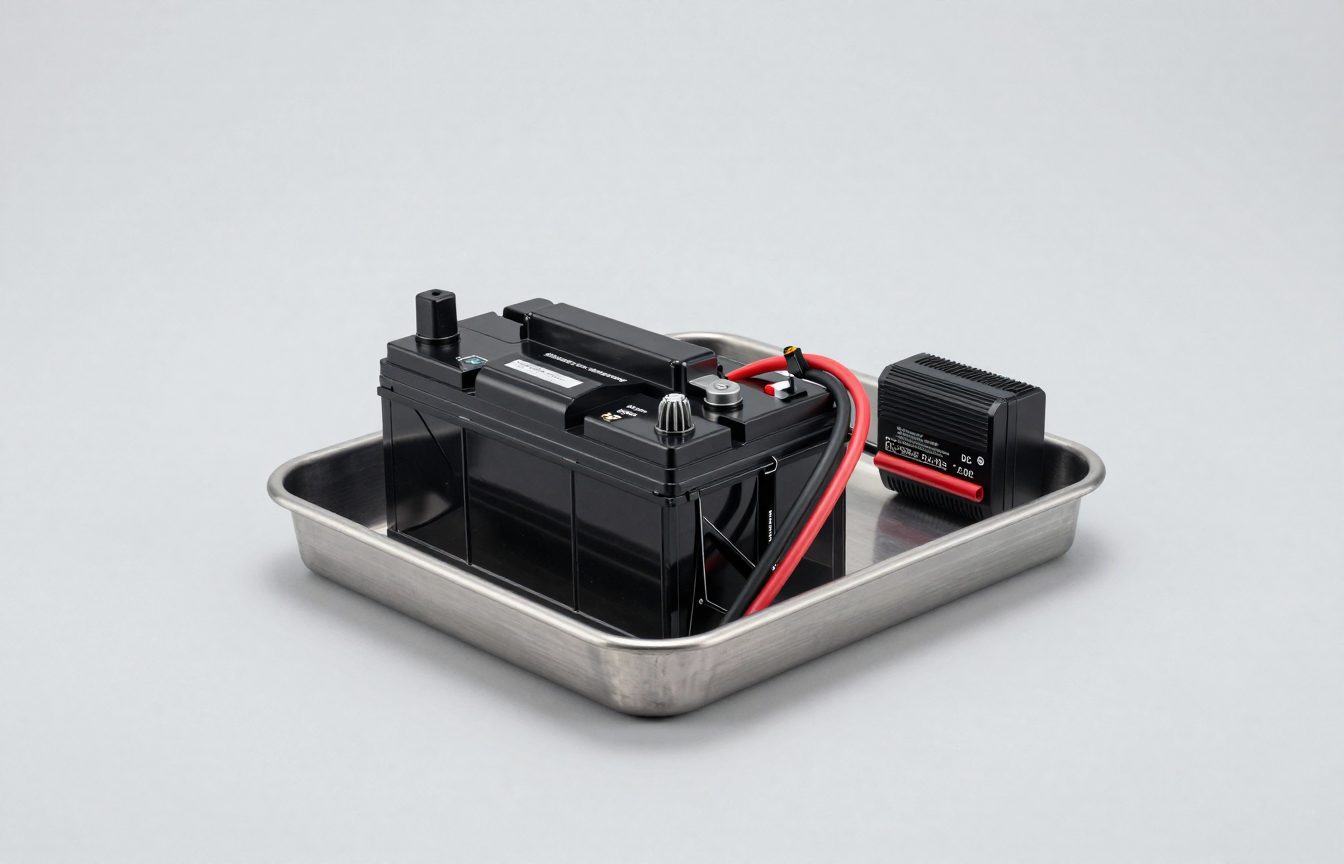
A dual battery system adds an auxiliary battery charged from the vehicle while you drive, isolated so it cannot flatten the starting battery. Most late-model vehicles need a DC-DC charger rather than a simple isolator, because their alternators vary voltage. Add the right cable size, fuses at both ends, and count the weight against your payload.
The parts
- An auxiliary battery. Deep-cycle AGM or lithium (LiFePO4).
- A charger or isolator. Charges the auxiliary battery from the alternator and stops it draining the starting battery.
- Cabling and fuses, sized for the current and the run length, protected at both ends.
- A tray or box, secured in the engine bay, tub, canopy or van.
- Outlets: Anderson plugs, 12V sockets, USB, and often a feed to the caravan.
DC-DC charger or isolator?
- Voltage-sensitive isolator (VSR): joins the batteries when the alternator is charging and separates them when it stops. Simple and cheap; best on older vehicles with fixed-voltage alternators and an AGM auxiliary battery.
- DC-DC charger: a proper multi-stage charger fed from the starting battery. It works with variable-voltage ("smart") alternators fitted to most late-model vehicles, charges lithium correctly, and usually accepts solar input too. For a modern ute or van, this is the usual choice.
Lithium or AGM?
| AGM | Lithium (LiFePO4) | |
|---|---|---|
| Usable capacity | About half the rated amp-hours | Most of the rated amp-hours |
| Weight | Heavy | Much lighter for the same usable energy |
| Charging | Simple | Needs a charger set for lithium |
| Price | Lower | Higher |
Weight matters because every kilogram counts against your GVM, and while towing, against what is left at full tow.
Does your vehicle have a smart alternator?
This is the question that decides the whole system. REDARC, an Australian maker of DC-DC chargers, explains that vehicles newer than 2015 are more likely to have a smart alternator, and some earlier models do too. A smart alternator varies its output voltage and often lowers the voltage supplied while you drive, to cut engine load and emissions. That is fine for the starting battery, but it leaves too little voltage to charge a second battery properly through a simple isolator. REDARC's advice is that vehicles with variable-voltage smart alternators must use a DC-DC charger for the auxiliary battery; with a traditional fixed-voltage alternator, a smart battery isolator remains an option.
Signs you probably have one: the vehicle is a late-model ute, van or 4WD; the battery voltage you see on a dash display or a plug-in meter drops to around 12.5 volts or so while cruising, rather than sitting near 14; or the battery has a sensor on its negative terminal. When in doubt, plan on a DC-DC charger.
Sizing the auxiliary battery
Work backwards from what you will run. Add up the amp-hours each device uses in a day, then add a margin for cloudy days and slow driving.
| Device | Typical draw | Hours a day | Amp-hours a day |
|---|---|---|---|
| 40 to 50 litre compressor fridge | About 1 to 2 A averaged over the day | 24 | 24 to 48 Ah |
| LED camp lights | About 1 A | 4 | 4 Ah |
| Phone and tablet charging | About 2 A | 3 | 6 Ah |
| Water pump (caravan) | About 4 A | 0.5 | 2 Ah |
| Total | About 36 to 60 Ah |
These are illustrative figures; your fridge's manual and a battery monitor give real ones. With that load, a lithium battery of around 100 Ah, of which most is usable, covers a day or two without driving or solar. An AGM battery gives roughly half its rated capacity before you should recharge it, so the same job needs about twice the rated amp-hours, and twice the weight.
How much charging do you need?
A DC-DC charger delivers a set current, commonly 20, 25, 40 or 50 amps. As a rough guide, a 25 A charger puts back about 25 Ah for each hour of driving, less when the battery is nearly full. If you use 50 Ah a day and drive an hour, a 25 A charger will not keep up on its own; solar input or a larger charger will. Many DC-DC chargers accept a solar panel input directly and switch between the two, which is useful at camp. Match the charger's current to what the battery maker allows; REDARC notes that charging an auxiliary battery directly from the alternator risks exceeding the battery's recommended current.
Cable, fuses and the run to the battery
The cable from the starting battery to the charger, and from the charger to the auxiliary battery, carries the full charging current. Too thin and it drops voltage and heats up; on a long run to a canopy or a caravan, this is the most common weak point. Size the cable for the current and the full length of the run, follow the charger maker's cable table, and fit a fuse or circuit breaker close to each battery, so a short anywhere along the cable cannot draw unlimited current. Secure the cable away from exhaust heat and sharp edges, with grommets where it passes through metal. Our Anderson plug guide covers the connector used for the caravan link.
Where to put the second battery
| Location | Good | Watch |
|---|---|---|
| Engine bay | Short cable run, out of the way | Heat shortens battery life, especially lithium; check the battery maker's temperature limits |
| Ute tub or canopy | Cooler, easy access, room for a bigger battery | Longer cable run; secure it so it cannot move in a crash |
| Van or caravan | Close to the loads it powers | Longest run from the alternator; DC-DC charger near the battery |
Wherever it goes, it must be fixed down. A loose 25 kg battery is a dangerous object in a sudden stop.
Payload and weight
A dual battery system is easy to underestimate on the scales. An AGM battery of around 100 Ah weighs roughly 25 to 30 kg; a lithium battery of similar rated capacity often weighs around half that or less. Add the charger, tray or box, and cabling, and an AGM system can approach 40 kg before you count the fridge it runs. That weight comes straight out of payload. If you also tow, remember it is part of what Transport for NSW tells you to weigh: the loaded vehicle must stay under its GVM with the van hitched. Our GVM meaning guide explains the limits.
A typical install, step by step
- Confirm the alternator type and choose a DC-DC charger to suit, set for your battery chemistry.
- Choose the battery location and mount the tray or box securely.
- Run correctly sized cable from the starting battery, fused close to it, to the charger.
- Connect the charger to the auxiliary battery, fused close to that battery.
- Connect the ignition or vehicle-running signal if the charger needs one.
- Wire the outlets (Anderson, 12V sockets, USB) from the auxiliary battery through their own fuses.
- Fit a battery monitor if you want to see what is going in and out.
- Test: start the engine, confirm the charger switches on and the auxiliary battery charges, then confirm the starting battery is not drawn down when the engine is off.
Wiring a vehicle's high-current circuits has real fire risk if done badly. If you are not confident, have an auto electrician do it.
Adding solar
Solar keeps the auxiliary battery topped up at camp, when the engine is not running. A rough guide: a 200 watt panel in good sun can put back somewhere around 40 to 60 amp-hours over a summer day, much less in winter, cloud or shade. Many DC-DC chargers have a built-in solar regulator (often MPPT, which gets more from the panel in varying light), so the panel plugs straight into the charger. A portable panel or blanket can sit in the sun while the vehicle parks in shade, which also keeps the fridge cooler. Use the illustrative load table above to see whether solar covers your daily use.
Lithium: what is different
Lithium iron phosphate (LiFePO4) batteries are the common choice for new systems because they are light and give most of their capacity, but they have a few rules of their own:
- They need a charger profile set for lithium. The DC-DC charger and any solar regulator must be set to the battery maker's charging voltages.
- They have a battery management system (BMS) inside that cuts off charging or discharging to protect the cells. That is a safety feature, not a fault, if the battery shuts down when very cold, very hot or empty.
- Voltage is a poor fuel gauge. A lithium battery holds a nearly flat voltage across most of its charge, so a voltmeter tells you little. A shunt-based battery monitor that counts amp-hours in and out is far more useful.
- Heat matters. Mount lithium away from engine heat and direct sun where you can, and follow the maker's temperature limits for charging.
When an isolator is still fine
A simple voltage-sensitive isolator is still a reasonable choice for an older vehicle with a fixed-voltage alternator, a short cable run and an AGM auxiliary battery, used mainly for weekend trips. It is cheaper and has fewer parts. As REDARC notes, a smart battery isolator is an option with a traditional alternator. It is the wrong choice for a smart alternator, a lithium battery or a long run to a caravan, where a DC-DC charger does the job properly.
Charging a caravan battery from the car
Many people want the tow vehicle to charge the caravan's battery on the road. The cable from the car's battery to the van is long, often 8 to 10 metres each way, so voltage drop is the enemy. The common, reliable layout is a heavy cable from the car's battery to an Anderson plug at the towbar, and a DC-DC charger mounted in the van, close to the van's battery. The charger then compensates for the voltage lost along the cable and charges the van battery with the right profile. Check that the car end is fused and that the van's charger is set to the van battery's chemistry.
Common mistakes
- Using an isolator with a smart alternator, so the auxiliary battery never fully charges.
- Cable too thin for the run, especially to a canopy or caravan.
- No fuse near one of the batteries.
- Lithium battery on a charger profile set for AGM.
- Battery not secured, or mounted where engine heat cooks it.
- Forgetting the weight when checking payload and GVM.
Fridges: the biggest load
For most dual battery setups, the fridge is the load that decides everything. A compressor fridge cycles on and off, so its average draw depends heavily on the outside temperature, how full it is, how often the lid opens, and whether it sits in shade with room to breathe. The same fridge can use twice as much on a 38°C day in a hot canopy as on a mild day in an air-conditioned cabin. Practical ways to cut its use: pre-cool it and its contents on mains power before you leave, keep it out of direct sun, leave the vents clear, and use an insulated cover. A battery monitor shows the effect clearly within a day.
Do you need a dual battery at all?
Not always. For a weekend with a small fridge and a few short drives, a portable power station or a lithium battery box charged at home may be enough, without permanent wiring. If you camp for several days, run a fridge full time, tow a van that needs charging, or work from the vehicle, a properly installed dual battery system with a DC-DC charger is the reliable answer.
Battery monitors: knowing what you have left
A battery monitor with a shunt measures every amp going in and out, and shows the state of charge as a percentage and the time left at the current draw. It turns a dual battery from guesswork into something you can manage: you can see the fridge's real daily use, whether the DC-DC charger is putting back as much as you think, and how much solar is arriving. For lithium batteries, whose voltage barely changes until they are nearly empty, a shunt monitor is close to essential. Fit it on the negative side of the auxiliary battery, so every load and every charging source passes through it.
Keeping the system healthy
- Check terminals and fuse holders for tightness and heat discolouration every few months.
- Keep the battery and charger clean and dry; dust and moisture in the engine bay shorten their life.
- Do not leave a lead-acid or AGM battery flat; recharge it as soon as you can.
- Store lithium at a partial charge if the vehicle will sit for months, following the battery maker's advice.
Who should install it
A simple plug-in battery box needs no installer. A permanent dual battery system with high-current cable through the firewall, fuses at the starting battery and a DC-DC charger is a job many owners hand to an auto electrician, and that is the safer choice if you are not sure about cable sizing and fusing. Ask for the cable sizes, fuse ratings and the charger's settings to be written on the invoice, so you can check them later and so the next owner knows what was fitted.
Planned range
When we open, we plan to stock DC-DC chargers, auxiliary batteries, trays and Anderson-plug wiring kits. No prices or stock yet.
Common questions
Do I need a DC-DC charger?
On most late-model vehicles with variable-voltage alternators, yes: a simple isolator will undercharge the auxiliary battery. A DC-DC charger is also needed to charge lithium properly.
How much does a dual battery system weigh?
It depends mostly on the battery: a lithium battery is much lighter than an AGM of similar usable capacity. Count the battery, tray, charger and cabling against your payload.
Sources
Hitch & Highway is a towing and van gear store in preparation and is not trading yet.